What is a telomere test, and what can it tell you?
Telomeres are the protective tips on the ends of your DNA, and they get shorter as you age. Here is what a test measures, what it can and can't tell you, and who it's for.
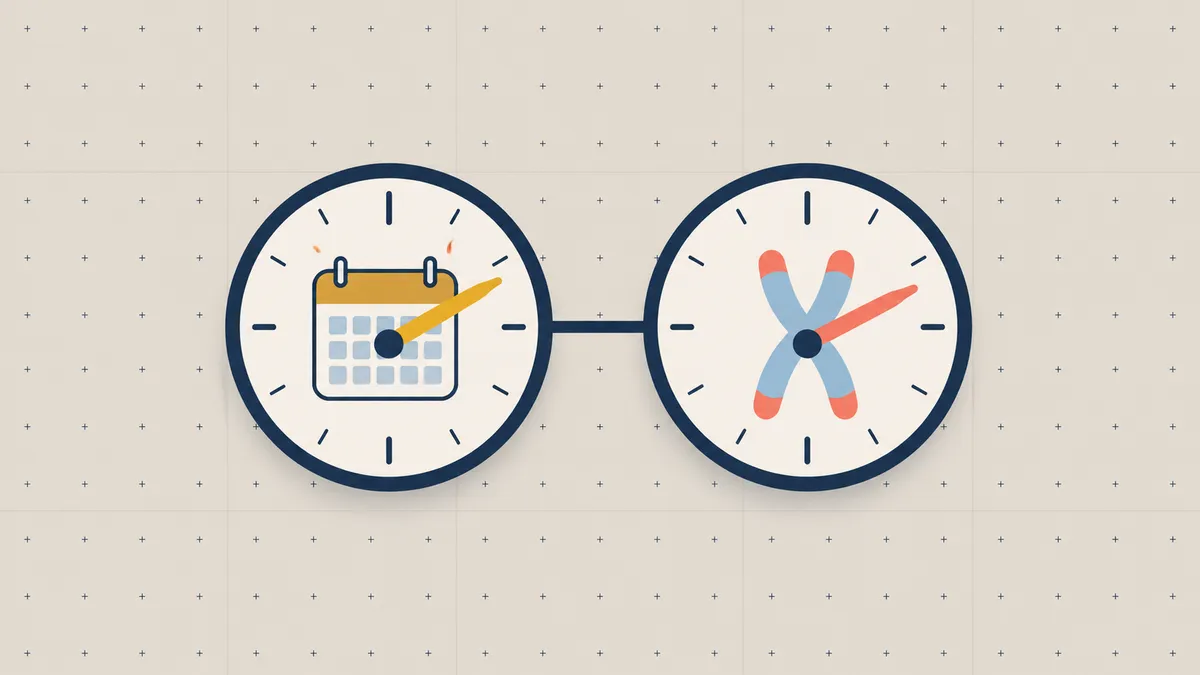
Quick answer: a telomere test measures the length of your telomeres, the protective caps on the ends of your DNA. Telomeres get shorter as you age, so some companies use the test to estimate how fast your body is aging. Doctors also use it to diagnose a few rare inherited conditions. One result is a rough guide, not a verdict.
What a telomere is
Every cell in your body carries your DNA, packed into 46 long strands called chromosomes.
At both ends of every chromosome sits a telomere. It's a stretch of repeated DNA that doesn't carry any genes. Its only job is to protect the end.
Telomeres work like the plastic tips on your shoelaces. The tip isn't the useful part of the lace. It's there to stop the end from fraying. Lose the tip, and the lace starts to come apart.
Here's the catch. Every time a cell divides to make a copy of itself, its telomeres get a little shorter. In adults, that works out to about 25 base pairs a year on average, the tiny "letters" DNA is written in (a review of 124 studies).
After enough divisions they get too short, and the cell stops dividing. That's one of the ways bodies age, and it's why scientists started looking at telomeres as a possible clock for aging.
Why telomeres matter for your health
Across large studies, people with shorter telomeres in their blood cells are more likely to have heart disease.
Source: Haycock et al., BMJ, 2014. Relative risk; 1.0 means no difference.
longevityclinicshub.comIn plain terms: across 24 studies and 43,725 people, those with the shortest telomeres had about 1.5 times the risk of heart disease of those with the longest.
But longer isn't simply better. A large genetic study looked at people born with longer or shorter telomeres. Longer ones went with lower odds of heart disease, but higher odds of several cancers. For most other diseases it checked, there was little sign of a link either way.
These are patterns across big groups of people, not predictions about you. A telomere result can't tell you whether you have, or will get, a disease. It doesn't replace your blood pressure, cholesterol or cancer screenings.
Why one result is hard to read
The biggest problem with a telomere test is that it can't see where you started.
A fuel gauge showing a quarter tank looks the same whether a car with a small tank has barely moved, or a car with a big tank has driven a long way. The gauge shows what's left. It can't show the size of the tank, or how far you've driven.
A telomere test is that gauge. The length you were born with is the tank, and it varies a lot from person to person. What you've lost since is the distance.
When researchers measured 490 newborns and their parents, the babies' telomeres were longer, as you'd expect. But they varied from one another just as much as the adults' did.
Source: Factor-Litvak et al., Pediatrics, 2016. Babies varied from one another as much as their parents did.
longevityclinicshub.comThe usual spread in telomere length between newborns is about the same as 28 years of typical wear in an adult. Our math: the newborn spread (0.70 thousand base pairs, Pediatrics, 2016) divided by the average adult loss of 24.7 base pairs a year (Ageing Research Reviews, 2013).
So much of the difference between you and a stranger may have been there on the day you were born.
That's why one reading is so hard to judge. A short result can mean fast wear, a short start, or both, and one test can't tell which.
Why two labs can give you two answers
There are three main ways to measure telomeres, and they don't produce the same kind of number:
- qPCR, the most common. It compares the amount of telomere DNA with a gene every cell has one copy of, and gives a ratio.
- Southern blot, an older lab method that measures the length directly.
- Flow-FISH, which makes the telomeres inside each cell glow and measures how bright they are. Hospitals use it.
When ten labs were sent the same DNA samples, their results differed so much that the researchers concluded labs can't share normal ranges.
Source: Martin-Ruiz et al., International Journal of Epidemiology, 2015. 10 labs, the same 10 samples, measured blind.
longevityclinicshub.comTo put that in context: a 20% difference on a typical adult result is more than the length an adult loses, on average, in 50 years (our math, using the numbers above).
Only compare a result with an earlier one from the same lab, using the same method. A change between two companies says more about the labs than about you.
What the test is like, and what you get back
For you, it's simple: a sample, then a wait. Most tests use a blood draw. Some use a different kind of sample, which is worth asking about, because telomere length differs between types of cells.
Your result usually comes back as one of three things: a length, a ratio, or a percentile that compares you with people your age.
Some companies also turn it into a "telomere age". That age is worked out by a model, not measured by the lab. The difference is explained in measured vs derived biomarkers. The percentile is the most useful number, as long as you know which method and which comparison group it came from.
Enter your ZIP code to see clinics near you that offer telomere and biological age testing.
Telomere test vs biological age test
Telomere length is one way to estimate how your body is aging. The other one you'll hear about most is an epigenetic clock, which reads chemical marks on your DNA instead of the length of its tips. How those work is covered in biological age tests.
One study ran eleven different aging measures, including telomere tests and epigenetic clocks, on 964 people born within a year of each other in one New Zealand city. The measures didn't agree well with each other.
Some of the clocks lined up with how well people moved, how their memory held up and how old they looked. The telomere measures didn't. It's one study, but it's the clearest side-by-side test so far.
Where the test really matters
Telomere testing has one proven medical use: helping specialists diagnose rare inherited conditions where the body can't look after its telomeres.
One of them, dyskeratosis congenita, affects about 1 in a million people. Signs can include nail and skin changes, bone marrow that doesn't make enough blood cells, lung scarring and early gray hair.
In one hospital study of 38 people under 40 with bone marrow failure, the telomere result changed the treatment plan for about 1 in 4. That's the test doing real work: a specialist, a specific question, and a decision that depends on the answer.
Can you make your telomeres longer?
Maybe a little, with exercise. A review of seven trials with 939 people found a small benefit from aerobic exercise, like brisk walking, running or cycling, kept up for six months or more. Strength training on its own didn't show the same effect.
The trials tested exercise, not supplements. If someone sells you a supplement for your telomeres, ask what studies in people back it up.
The best reasons to exercise are the ones you can measure clearly: fitness, strength, blood pressure and blood sugar. A small change in telomere length over a few months is easily lost in the measuring differences above. If you do retest, see baseline testing vs retesting for how to tell a real change from noise.
Is a telomere test worth it for you?
It's better for curiosity than for decisions, and there's nothing wrong with curiosity.
It may be worth it if you enjoy tracking research measures and can hold the result loosely, or if you're joining a study. The one time it answers a medical question is when a specialist is looking for an inherited telomere condition, and then the specialist arranges it.
If you want a number you can act on, look elsewhere first. VO2 max, strength, blood pressure and standard blood tests tell you more, and they respond to change in clearer ways. Start with VO2 max.
Questions to ask before you book:
- Which method do you use: qPCR, Southern blot or flow-FISH?
- What kind of sample, and which cells does the result describe?
- Who is in the comparison group behind my percentile?
- If I retest, will it be the same lab, method and sample type?
Common questions
Is a telomere test the same as a biological age test?
Not quite. Some biological age tests measure telomere length, but many others read chemical marks on your DNA, called an epigenetic clock. The two measure different things and don't agree well, so ask which one you're buying.
Can a telomere test tell me how long I'll live?
No. Shorter telomeres are linked with some diseases across large groups of people, but the link is modest, longer telomeres go with higher odds of some cancers, and your result is shaped a lot by the length you were born with.
Do supplements lengthen telomeres?
The trials described on this page tested exercise, not supplements, and even there the effect was small. If a clinic recommends a supplement for your telomeres, ask what studies in people it's based on.
Can I compare my result with a friend's from a different company?
Not reliably. Labs use different methods and comparison groups, and a ten-lab study found the differences too big for labs to share normal ranges. Only compare a result with an earlier one from the same lab and method.
Is a low result something to worry about?
On its own, usually not. It may reflect a short starting length as much as anything since. If you also have blood count problems, lung scarring or a strong family pattern, raise it with your doctor, who can decide whether a specialist test makes sense.
Prepared by the LongevityClinicsHub editorial team. How we research and source these guides.
Enter your ZIP code to see clinics near you that offer telomere and biological age testing.
Keep reading

Sources
- National Human Genome Research Institute, Talking Glossary: Telomere
- Factor-Litvak P et al., Leukocyte telomere length in newborns. Pediatrics, 2016
- Müezzinler A, Zaineddin AK, Brenner H. A systematic review of leukocyte telomere length and age in adults. Ageing Research Reviews, 2013
- Martin-Ruiz CM et al., Reproducibility of telomere length assessment: an international collaborative study. International Journal of Epidemiology, 2015
- Lindrose AR et al., Method comparison studies of telomere length measurement using qPCR approaches. PLOS ONE, 2021
- Haycock PC et al., Leucocyte telomere length and risk of cardiovascular disease. BMJ, 2014
- Haycock PC et al., Association between telomere length and risk of cancer and non-neoplastic diseases: a Mendelian randomization study. JAMA Oncology, 2017
- Belsky DW et al., Eleven telomere, epigenetic clock, and biomarker-composite quantifications of biological aging. American Journal of Epidemiology, 2018
- MedlinePlus Genetics: Dyskeratosis congenita
- Alder JK et al., Diagnostic utility of telomere length testing in a hospital-based setting. PNAS, 2018
- Song S et al., Does exercise affect telomere length? A systematic review and meta-analysis of randomized controlled trials. Medicina, 2022
This guide is independent editorial content, written to orient, not to diagnose. It is not medical advice, and it is no substitute for a conversation with a licensed physician who knows your history. Where we describe what clinics claim, the claim belongs to the clinic.
Educational reading, not medical advice. Talk to a clinician about your own health.